Stroke Recovery at Home: Best Physical Therapy Exercises for Survivors
Recovering from a stroke takes time, but the right exercises can make all the difference. Learn the most effective at-home physical therapy exercises for stroke survivors—from core balance and leg strengthening to hand mobility and fine motor skills—to improve independence, mobility, and quality of life.
Jason Lamendola PT
10/2/20252 min read
Introduction
Stroke is one of the leading causes of neurological disability in older adults. By age 55, the lifetime risk of stroke is significant—affecting 1 in 5 women and 1 in 6 men. With an aging population, the number of people living with the effects of stroke continues to rise.
Risk factors for stroke include age, hypertension, high cholesterol, diabetes, obesity, atrial fibrillation, smoking, and heart disease. Many survivors were already less active and living with underlying health conditions before experiencing a stroke.
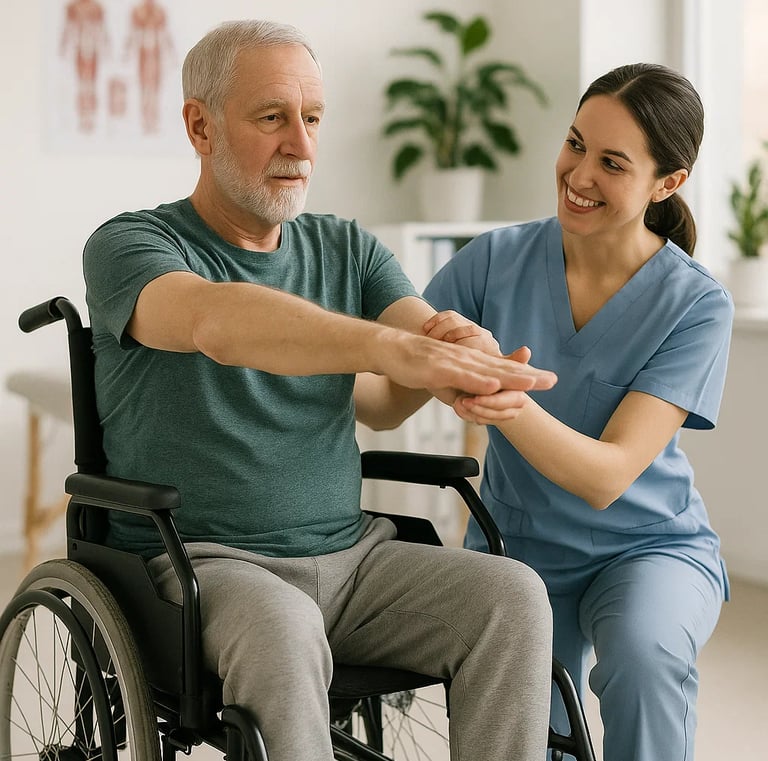
Recovery doesn’t end at the hospital. At-home rehabilitation exercises are crucial for helping stroke survivors regain strength, mobility, and independence while supporting brain healing through neuroplasticity.
At-Home Stroke Recovery Exercises
Core Balance Exercises
Strengthening the trunk improves stability, posture, and gait.
Knee-to-Chest: Builds core strength and improves circulation.
Toe-Tap Core Exercise: Engages abdominal and hip muscles, enhancing flexibility and coordination.
Trunk Rotation: Improves balance, postural alignment, and functional movement.
Arm Rehabilitation Exercises
Essential for regaining independence in daily tasks.
Tabletop Circles: Improves coordination, joint stability, and circulation in the arms.
Open Arm Stretch (External Rotation): Restores flexibility, posture, and reaching ability after stroke.
Leg Rehabilitation Exercises
Strengthening the lower body enhances balance, walking, and safety.
Knee Extension: Builds quadriceps strength and supports functional movement.
Ankle Dorsiflexion: Improves gait efficiency, balance, and ankle flexibility.
Seated Matching: Stimulates cognition, memory, and visual tracking while improving core stability.
Upper Extremity Exercises
Prevent and manage conditions like frozen shoulder or shoulder subluxation.
Tabletop Forward Push: Promotes grip strength, coordination, and confidence.
Tabletop Lateral Push: Strengthens the upper body, improves ROM, and enhances daily movement.
Hand, Wrist, and Finger Exercises
Crucial for regaining fine motor skills and independence.
Hand Surface Stretch: Relieves stiffness, improves flexibility, and enhances circulation.
Pen Spin: Boosts grip strength, hand-eye coordination, and focus.
Hand Rolling Movements: Improves ROM, reduces spasticity, and restores coordination.
Paralysis Rehabilitation Exercises
Passive movements help stimulate the brain and promote recovery in affected limbs.
Palms Up and Down: Encourages neuroplasticity and motor recovery.
Cane Rotation: Enhances shoulder mobility, balance, and stimulation of weakened areas.
Takeaway
Stroke rehabilitation is a long-term process, but consistent at-home physical therapy can dramatically improve recovery outcomes. Research shows that survivors who commit to exercise for 6–8 months see significant improvement—and neuroplasticity (the brain’s ability to adapt and form new connections) continues throughout life.
By sticking to a structured at-home therapy plan, stroke survivors can rebuild strength, regain mobility, and achieve greater independence well beyond inpatient care.
At TLC Physical Therapy, our team specializes in guiding stroke survivors through safe, effective exercises tailored to their recovery needs. Don’t face stroke recovery alone—let us help you take the next step toward independence.